


Brand Visibility in the Age of AI
By: Lauren Wootton, Co-Founder and CEO, ADELE

Every generation has had its own way of finding answers. For Boomers, information was often earned through effort. You drove from store to store comparing prices before making a purchase. You asked neighbors for recommendations. You read the newspaper, trusted institutions, and took pride in “doing your homework.” The process itself mattered because the search built confidence in the decision.
Then came Gen X, who learned to navigate both worlds. They adapted to the rise of the internet while still carrying some skepticism about what they found online. They researched deeply, compared sources, and became fluent in the early language of digital discovery.
Millennials changed the pace entirely. Convenience became the goal. Amazon removed the friction of shopping. Smartphones collapsed time and distance. Streaming replaced browsing. One-click purchasing rewired expectations. Information was no longer something you hunted for. It was something delivered to you instantly.
Now Gen Z and Gen Alpha are growing up in environments where asking a question and receiving an immediate, synthesized answer feels entirely natural. Not to say they don’t like to do their research, but they increasingly expect technology to help organize, simplify, and contextualize information quickly, intelligently, and accurately.
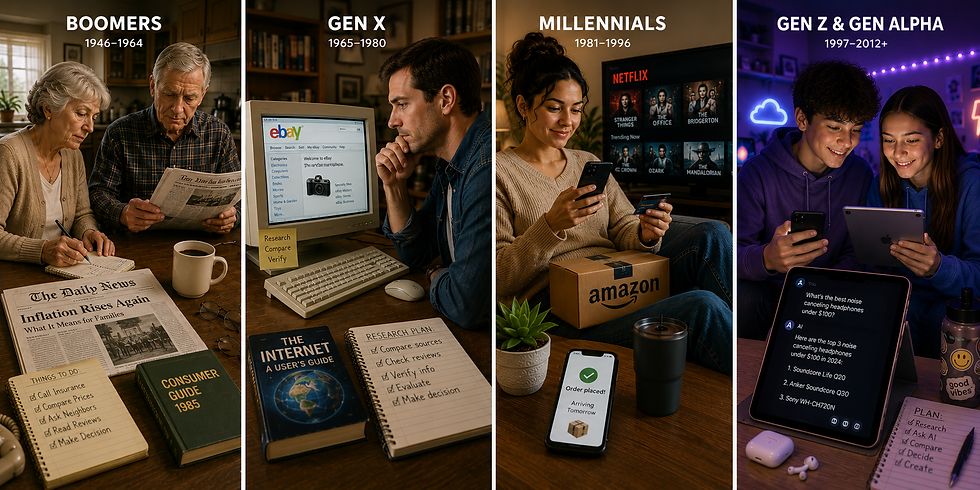
Technology has long shaped how generations consume information, evaluate credibility, and interact with the world around them.
The evolution of the internet reflects that same trajectory, from directories, to search engines, to algorithms, and now to AI-generated answers. Artificial intelligence is fundamentally changing how people discover and evaluate brands. And as consumer behavior evolves with advances in technology, so too must the strategies organizations use to be front and center.
The Shift From Rankings and Research to Automation and Answers
For nearly twenty years, Search Engine Optimization or SEO was the undisputed framework for digital visibility. Brands fought for rankings because rankings determined traffic, and traffic determined opportunity. If your company appeared near the top of a Google search, you had a chance to earn attention.
But the responsibility for interpretation still belonged to the consumer. Search engines gave users options. Humans did the work from there. Someone searching for a law firm, financial advisor, healthcare provider, or communications agency might open ten tabs, compare websites, read reviews, evaluate credibility, and eventually make a decision after hours or days of research.
That model is rapidly changing; however, some fundamentals (a great website, custom photography and videography, compelling storytelling, an active social presence, friendly and accessible customer service, etc.) remain necessary to build trust. That’s a whole other topic our team will cover in a future blog.
We want to focus on AEO and GEO and why understanding these relatively new concepts is critical to success. Platforms like ChatGPT, Gemini, Claude, Perplexity, and Google AI are fundamentally reshaping consumer expectations around how information should be delivered. Users are no longer being conditioned to search, sift, compare, and interpret information themselves. They are being conditioned to expect immediate answers delivered with speed, accuracy and confidence.
Not links. Not rankings. Answers.
Instead of typing into Google… “Top cardiologists in Miami” people increasingly ask their favorite virtual friend… “Who can I trust for cardiology in South Florida?” And they expect a synthesized recommendation immediately.
That shift may sound subtle, but it represents one of the most significant changes in digital behavior since the birth of search itself.
AI doesn’t simply retrieve information the way traditional search engines did.
It interprets information. It prioritizes information. It makes decisions about what sources appear authoritative enough to include in the answer.
And while the industry argues whether AEO and GEO are the same or not, we care less about that and more about what to do about them.
Many of our clients have asked us for counsel on how they can adapt to this transition. If you’re a business or organization looking to grow brand awareness, strengthen credibility, or shape how you are perceived, all of this deeply matters to you.
Collectively, the experts at our firm have spent decades adapting content, communications, and marketing strategies for evolving audiences, platforms, and technologies. Today’s shift toward AI-driven discovery is simply the next evolution.
We are actively monitoring these rapid changes, studying how audiences engage with emerging technologies, and adapting strategies in real time to ensure our clients remain visible, credible, and competitive in the environments shaping modern decision-making.
Here’s our take and why it matters.
AEO: Helping AI Understand Your Expertise
Answer Engine Optimization, or AEO, is the natural evolution of SEO in an AI-driven world.
Where SEO focuses on helping users find your content, AEO focuses on helping artificial intelligence understand your expertise clearly enough to surface it in direct responses. This changes the nature of content strategy. AI systems increasingly appear to favor clarity, authority, and conversational expertise over heavily optimized marketing language.
The companies most likely to surface in AI-generated answers are the ones producing genuinely useful content: educational insights, executive perspectives, clear explanations, FAQs, research, and expertise communicated in straightforward language.
Structured formatting (like bulleted lists), semantic clarity, and well-organized content architecture also help AI systems interpret and surface information more effectively.
Can AI confidently interpret what your organization knows and connect it to the questions people are asking? That is the new challenge.
But visibility alone is no longer enough. AI doesn’t simply retrieve information from your website. It synthesizes signals from the broader digital ecosystem surrounding your brand.
GEO: Helping AI Understand Your Credibility
This is where Generative Engine Optimization, or GEO, becomes critically important.
If “content is king,” we would argue that in the age of AI, credibility is queen. If AEO helps AI understand your expertise, GEO helps AI understand your credibility. More specifically, GEO focuses on influencing how generative AI systems reference, summarize, position, and contextualize brands within AI-generated responses. GEO is shaped by the broader digital footprint surrounding your organization. AI systems absorb signals from across the ecosystem: earned media coverage, executive interviews, podcasts, reviews, public sentiment, industry mentions, thought leadership, social conversations, and third-party validation. Increasingly, AI systems are not simply interpreting webpages; they are building interconnected understandings of brands, people, industries, and expertise through entity-based relationships across the web. In many ways, GEO is less about rankings and more about references. The brands most likely to influence AI-generated conversations are the brands most consistently cited, discussed, and validated across trusted digital environments. In other words, reputation itself has become machine-readable. For those of us who have spent years in the communications and reputation management space, this progression feels less surprising than inevitable. Long before artificial intelligence entered the mainstream, trust was already influencing visibility. Strong brands earned media attention more easily. Credible leaders attracted larger audiences. Organizations with clear messaging and consistent reputations naturally shaped public perception more effectively than those without them. AI is simply accelerating and operationalizing what marcomms professionals have understood for decades: authority matters, credibility compounds, and perception influences decision-making long before a transaction ever occurs. SEO asks: Can people find us? AEO asks: Can AI understand our expertise? GEO asks: Does AI recognize our authority strongly enough to reference and recommend us? SEO influences discoverability. AEO influences interpretability. GEO influences credibility. Together, they form the future of brand visibility. The More Things Change, The More They Stay the Same Increasingly, AI-powered discovery platforms are no longer behaving like directories. They are behaving like advisors -- interpreting, prioritizing, recommending, and shaping perception before consumers ever visit a website. The brands positioned to lead in the next decade will not win simply because they produce more content. They will win because they intentionally build authority, credibility, and relevance across every environment where artificial intelligence goes searching for answers. It goes without saying that things change faster than ever now and who knows what the future will truly hold, but it reminds our team of the old adage: “The more things change, the more they stay the same.” Even in the age of AI, the future still belongs to brands recognized as authoritative enough to be referenced, recommended, and trusted over the long run -- we would argue, it always has.


Comments